What causes eczema?
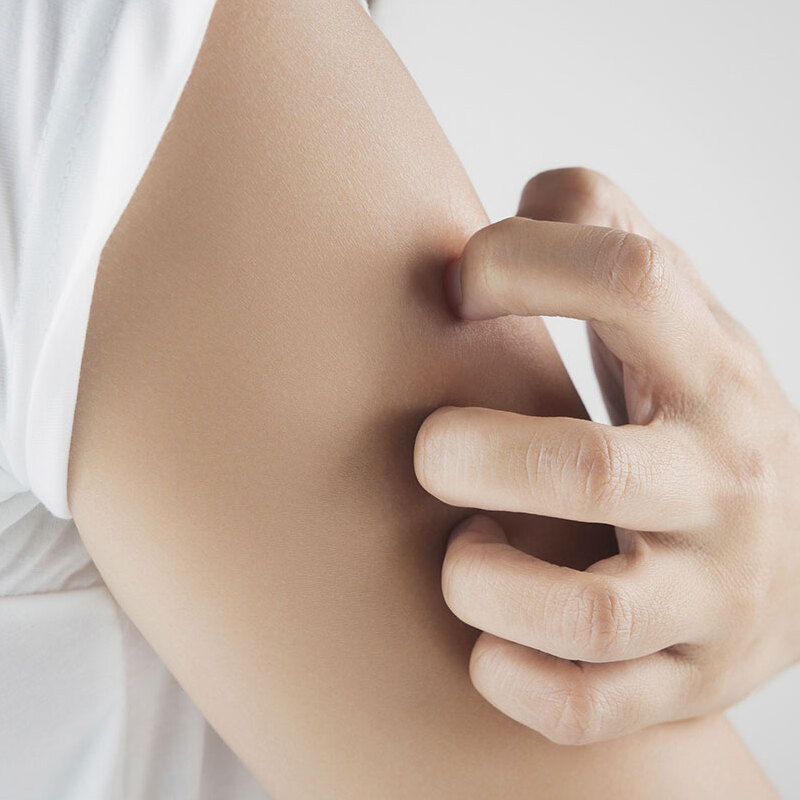
The skin is extremely dry and becomes more permeable, no longer playing its barrier role against external stresses and allergens. But not all dry skin becomes eczema.
Eczema develops on profiles with a genetic predisposition.
Studies have shown that if one parent has eczema-prone skin, the probability of the child having the same skin condition is 30%**. If both parents are affected, the probability is 70%**.
In addition to the genetic factor, eczema-prone skin is also related to:
- An abnormal immune system: which over-reacts, creating inflammation. The epidermis becomes permeable to allergens (mites, animal hair, pollen) and certain bacteria (Staphylococcus aureus), which trigger inflammatory reactions.
- Food allergies: cow’s milk, eggs, etc. are also involved digestively in triggering certain eczema flare-ups. Other factors such as chemical products applied to the skin, heat or perspiration are irritants that cause these flare-ups.
However, in the vast majority of cases, children who have eczmea do not have food allergies. Food allergies manifest themselves as digestive signs and a “break” in height and weight curves.
* Atopic dermatitis: epidemiology in France, definitions, natural history, association with other atopic manifestations, severity scores, quality of life (Atopic dermatitis: Epidemiology in France, Natural History, Association with Other Atopic Manifestations, Severity Scores, Quality of Life) . E. Mahé. Ann. Dermatol. Venereol. 2005; 132
**Dermatite atopique. SA Büchner. Swiss Medical Forum No. 19, May 2001
Eczema progression